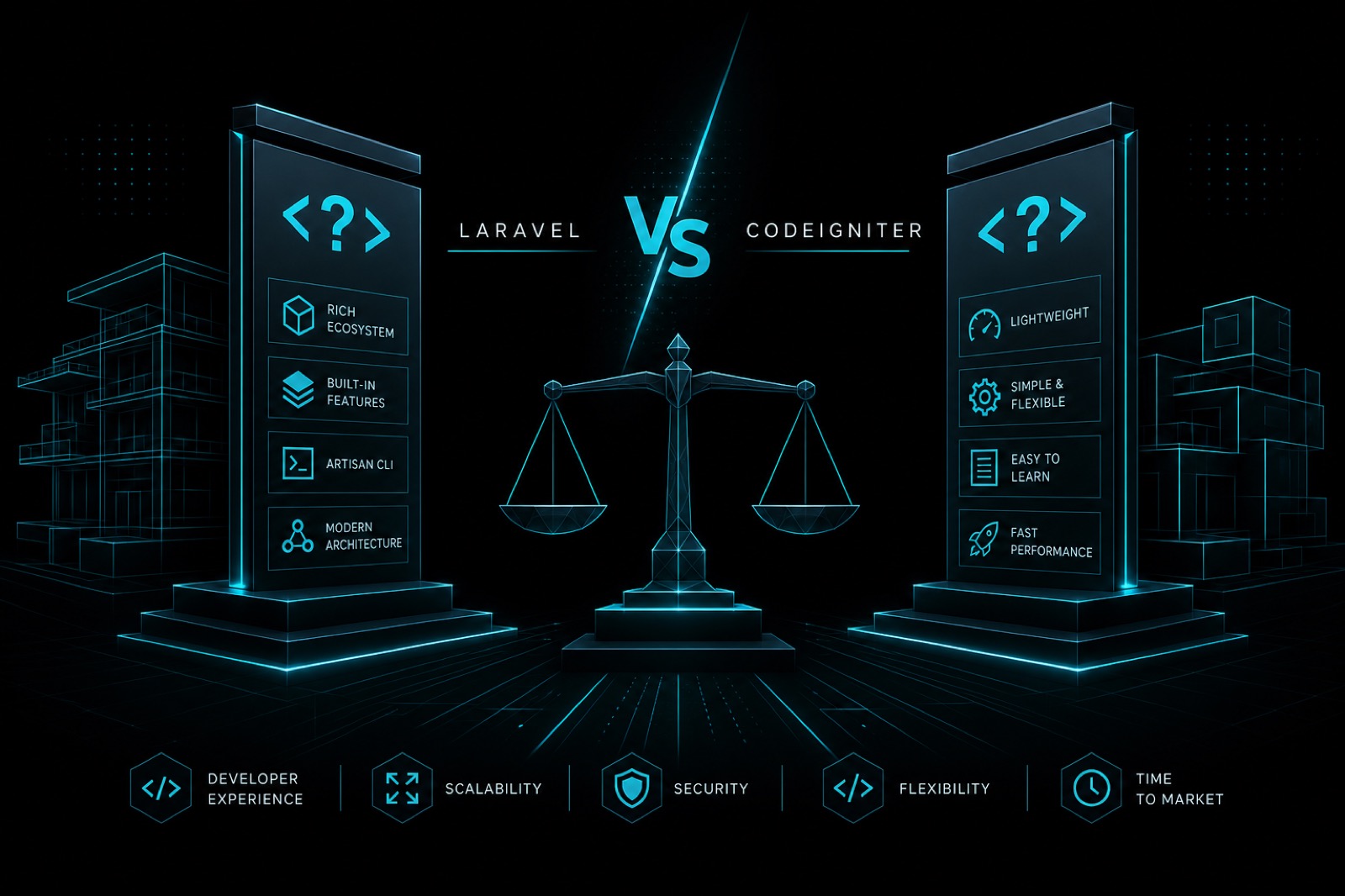
Laravel vs CodeIgniter: When to Choose Which for Client Projects
A practical Laravel vs CodeIgniter comparison for client work: delivery speed, complexity, team fit, maintenance cost, and a clear decision checklist.
On this page
A common kickoff question: Laravel or CodeIgniter? Both are PHP frameworks and both can ship products. The real difference is problem complexity, team size, and long-term maintenance cost.
Here is the decision framework I use when advising clients.
Clarify project context first
Ask:
- how soon do you need an MVP?
- will the system grow into many modules and roles?
- who maintains it after launch?
- do you need queues, events, a large API surface, or multi-tenant support?
Those answers matter more than framework preference alone.
When CodeIgniter is usually the better fit
CodeIgniter works well when:
- the project is focused (CRUD, simple APIs, internal portals);
- a small team wants a lighter framework footprint;
- hosting/resources are limited;
- architecture needs are not highly complex yet.
Its strengths: easy to learn, lightweight, and enough for many business systems with a clear scope.
When Laravel is usually the better fit
Laravel shines when:
- the product needs a mature ecosystem (queues, notifications, policies/permissions, expressive Eloquent);
- the team will grow and needs strong conventions;
- there are many integrations and background processes;
- tooling quality (migrations, testing, packages) is a priority.
For products expected to live for years with expanding features, Laravel often reduces mid-project architecture churn.
Factors teams often forget
1. Maintenance team capability
The “best” framework is still expensive if nobody can maintain it. Choose a stack that fits the client’s internal team or long-term partner.
2. Domain complexity
If business logic is complex (workflows, role matrices, billing, multi-branch operations), Laravel conventions and structure usually help.
3. Time to market
For a very tight MVP with small scope, CodeIgniter can get you live faster. For a platform that is already expected to grow, early Laravel investment is often safer.
Quick comparison
| Aspect | CodeIgniter | Laravel |
|---|---|---|
| Learning curve | Gentler for basic PHP | More concepts up front |
| Built-in features | Minimal and flexible | Rich and integrated |
| Best fit | Focused apps, light APIs | Growing products, complex systems |
| Long-term maintenance | Strong if scope stays controlled | Strong for feature growth |
Practical decision examples
- Company website + forms + light CMS: WordPress or a simple stack may be enough; if custom PHP is required, CodeIgniter can still make sense.
- Operations system with notification queues, complex roles, expanding modules: Laravel is usually the better choice.
- Early mobile API with limited endpoints: either can work; choose based on the next 12 months of roadmap.
Framework selection checklist
- write the 3-month and 12-month scope;
- assess maintenance team size/skills;
- list features that need queues, auth policies, or heavy integrations;
- estimate onboarding cost for a new developer;
- decide based on maintenance risk, not trends alone.
Conclusion
There is no universal winner. CodeIgniter is strong for lean, focused delivery. Laravel is strong for products that will grow with real complexity. The best choice is the one that honestly matches scope, team, and system future—not whichever framework is loudest in the feed this month.