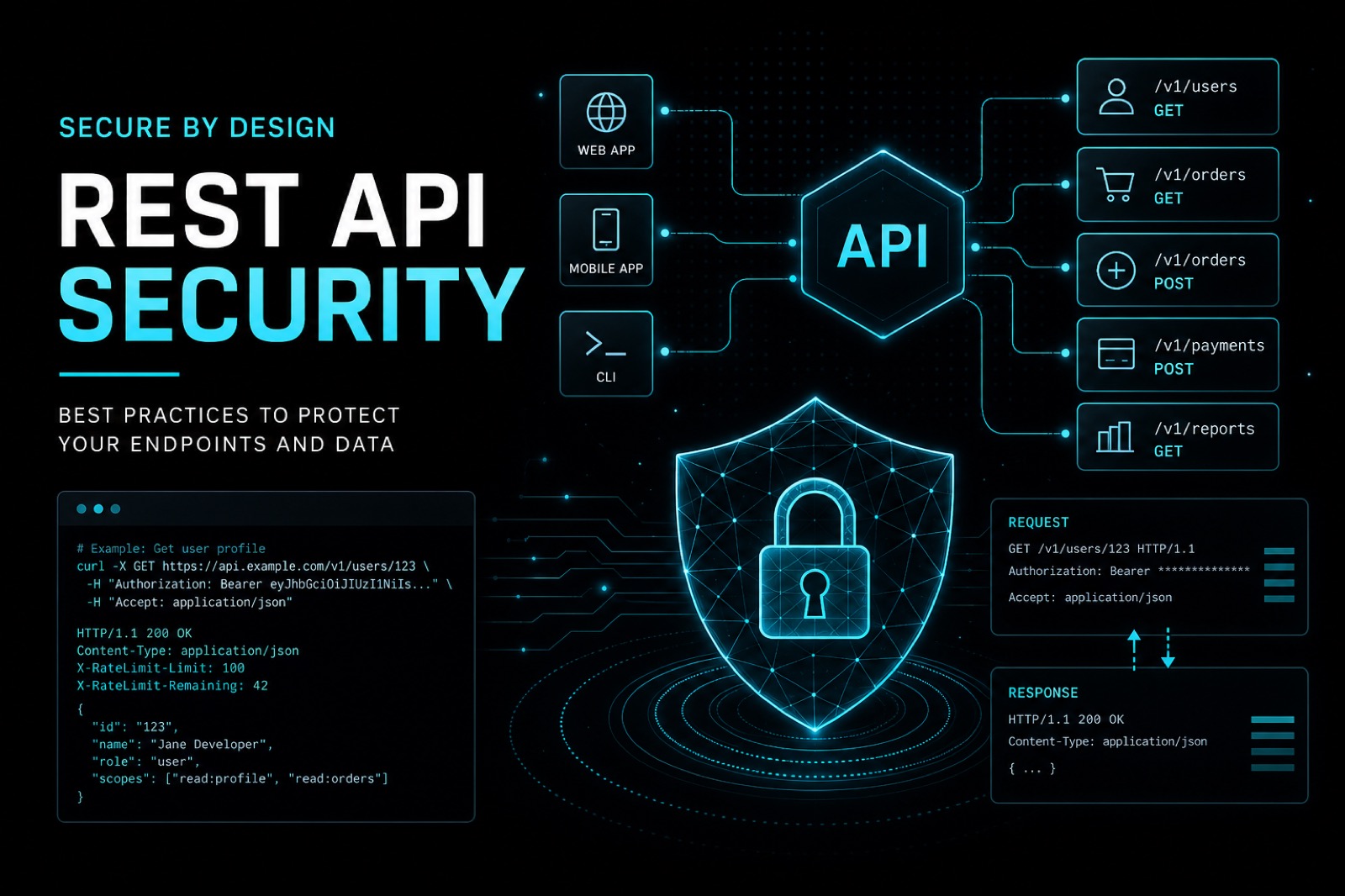
Building Secure and Maintainable CodeIgniter REST APIs
Practical CodeIgniter REST API patterns: endpoint design, authentication, input validation, consistent errors, and baseline performance.
On this page
Many digital products still rely on PHP-based REST APIs. CodeIgniter remains a solid option for internal APIs, mobile backends, and system integrations—when structure stays disciplined.
This article summarizes practices I use to keep APIs maintainable and safer.
Design the API contract before coding
Before writing controllers:
- define resources and HTTP verbs (
GET,POST,PUT/PATCH,DELETE); - agree on success and failure response shapes;
- document required fields, optional fields, and data types;
- version the API from day one (
/api/v1/...).
A clear contract reduces back-and-forth between frontend and backend teams.
Use a structure that can grow
Separate responsibilities:
- Controllers only accept requests and return responses;
- Services/Models own business logic and queries;
- Filters/Middleware handle auth, rate limits, and CORS;
- Validation stays centralized for inputs.
Avoid god-class controllers that mix queries, validation, and formatting.
Choose realistic authentication
For public or mobile APIs:
- use standard token patterns (JWT or opaque tokens with expiry);
- never put sensitive credentials in query strings;
- rotate secrets and revoke tokens on logout or compromise;
- separate permission scopes when multiple roles exist.
For internal service-to-service APIs, consider an API key plus IP allowlisting as an extra layer.
Treat input validation as first-line security
Assume every input is untrusted.
Minimum bar:
- validate field types and lengths;
- reject unknown payload fields when practical;
- sanitize outputs to reduce injection risk at relevant layers;
- limit upload sizes and request rates.
Keep error handling consistent
Clients should rely on one error format.
Principles:
400for invalid input;401/403for auth/permission issues;404when a resource is missing;429for rate limits;500for unexpected failures without leaking stack traces in production.
Include a human-readable code/message, plus a request_id when tracing matters.
Baseline performance often ignored
APIs feel slow for reasons beyond heavy queries.
Also check:
- N+1 queries on relations;
- database indexes for common filters/sorts;
- default pagination (never unbounded
SELECT *); - caching for rarely changing reference data.
Logging and observability
Without logs, production debugging becomes guesswork.
Record:
- endpoint, status code, and latency;
- client identity (without storing secrets);
- server-side exceptions with enough context.
API release checklist
Before deploy:
- test happy paths and validation failures;
- test expired/invalid tokens;
- test pagination and filters;
- lock CORS to required origins only;
- disable debug mode in production.
Conclusion
A good CodeIgniter REST API is less about the framework and more about clear contracts, strict validation, sensible auth, consistent errors, and measured performance. With that foundation, adding new endpoints becomes safer and faster.